
The AttendNC Guide for Teachers & School Teams provides a 90-day launch plan and tiered strategies to support universal attendance routines, early intervention, and intensive support. The guide also summarizes who’s most at risk, why attendance matters, and common drivers of chronic absenteeism.
Throughout the guide are links to high-quality, implementation-focused resources to help teachers and school teams enact the recommendations provided. To learn more about the research that informs this guide, read our Review of the Research.
Understanding Chronic Absenteeism
Chronic absenteeism is defined in the North Carolina Student Accounting Manual (p. 35) as missing 10% or more of enrolled school days for any reason (excused or unexcused). This threshold matters because it captures students who may not be labeled as “truant” but are still missing enough instruction to experience meaningful academic and developmental harm.
In North Carolina, nearly 400,000 students (24%), were chronically absent during the 2024–25 school year. The impact has been especially severe in high-poverty, rural, and urban schools. While chronic absenteeism rates in North Carolina have declined since their pandemic peak of 31%, and attendance bright spots can be found across the state, absenteeism levels in general remain well above pre-pandemic norms.
Chronic absenteeism is best understood as a multi-causal challenge shaped by student health and wellbeing, family circumstances, school climate, and community conditions. When absences persist, students miss instruction and supportive relationships in ways that can slow learning, strain engagement, and increase longer-term risk such as course failure and dropout. Moreover, research suggests that chronic absenteeism is best addressed by a tiered, data-enabled system that combines:
- Tier 1: strong universal conditions for attendance (culture, belonging, predictable routines, supportive climate)
- Tier 2: early intervention and targeted supports for emerging risk
- Tier 3: intensive, coordinated case management for persistent barriers
To make this tiered approach effective, schools first need a clear picture of why students miss school, including the barriers and experiences that drive repeated absences, as well as the impacts these missed days have on students.
Who's at Risk (and Why)?
Research consistently shows higher absenteeism rates among students who face structural barriers to attending school and students who experience weaker belonging and engagement at school. Research suggests elevated risk particularly for:
- Students from low-income households
- Students with disabilities
- English learners
- Students of color
- Students in high-poverty communities and schools
Common Causes of Chronic Absenteeism
Attendance teams are most effective when they identify what’s likely contributing to student absences and respond accordingly. Research points to several, often overlapping, causes:
- Logistical and structural barriers (outside of school)
- Transportation access and reliability (including route timing, distance, safety, and family vehicle instability)
- Health needs and limited access to healthcare (acute and chronic conditions)
- Housing instability, caregiving responsibilities, and family mobility
- Community safety concerns that make travel to school difficult or risky
- School climate, belonging, and stability (inside of school)
- Students are more likely to attend when they feel safe, known, and connected. School climate improvements have been linked to better attendance.
- Exclusionary discipline practices are associated with higher absence and disengagement, and may contribute to inequitable attendance patterns.
- Peer effects matter: attendance behaviors can cluster within classrooms and peer networks, indicating the importance of addressing absenteeism “hot spots,” not only individuals.
- Stability can help: having more familiar adults and peers across the day is associated with fewer absences.
- Anxiety-related absence and school refusal (student needs)
- Some students avoid school due to anxiety, stress, or other internalizing challenges.
- Research emphasizes that school refusal is heterogeneous and benefits from individualized supports rather than one-size-fits-all responses.
Key Takeaway: The fastest way to improve attendance is to respond early and specifically. Use data to spot emerging patterns, identify the likely cause, and apply the appropriate support before the pattern becomes chronic.
Why Attendance Matters
Chronic absenteeism is associated with meaningful harms for students, schools, and communities, such as:
- Academic Impacts
- Lower achievement and slower academic growth, particularly in reading and math
- Higher risk of course failure and grade retention, with elevated risks in secondary grades
- Increased likelihood of dropout or failure to graduate on time, especially when chronic absence is persistent
- Non-Academic Impacts
- Lower engagement and weaker connection to school
- Higher risk for disengagement cycles (absences lead to missed learning and strained relationships, which then increases avoidance)
- Compounding effects for students already facing stressors related to health, safety, or instability
- School and System Impacts
- Disruptions to instruction and increased staff workload (re-teaching, intervention support, crisis response)
- Reduced effectiveness of school improvement efforts by limiting access to instruction and school-based services
- Intensified inequities when absences concentrate among students who already experience academic gaps
Key Takeaway: Attendance is an enabling condition for everything else. When attendance improves, instructional time, relationships, and academic outcomes improve too.
A Practical 90-day Launch Plan for Schools
This 90-day launch plan helps schools move from awareness of the issue to consistent, measurable action. It focuses on building a shared classroom-and-team infrastructure first (shared definitions, data reporting, risk indicators, and routines), deploying a small set of Tier 1 and Tier 2 practices aimed at preventing chronic absenteeism, and finally establishing more intensive Tier 3 case management and a school learning cycle to refine and spread what works.
Planning and Implementation Readiness
Use time during summer break to prepare for consistent implementation on the first day of school by clarifying roles and routines, reviewing prior-year attendance patterns, and establishing Tier 2 and Tier 3 criteria and strategies so student supports are timely and predictable.
- Convene an attendance team and complete a readiness assessment. Complete the Attendance Works School Self-Assessment with a small cross-role attendance team to prepare for Tier 1 routines, Tier 2 follow-through, Tier 3 coordination, family engagement, and data use. Use results to set 2–3 near-term capacity building goals (for example, tighten re-entry routines, clarify Tier 3 case lead ownership, standardize outreach timelines).
- Determine shared definitions, roles, and meeting schedules. Align on what “chronic absence” and “emerging risk” means, and who owns which actions (teachers, grade teams, counselor/nurse/social worker, admin). Establish a regular meeting schedule: a short weekly/biweekly check-in plus a monthly student review.
- Establish data routines and conduct an attendance data review.
- Confirm when attendance data will be available, where it will live, and how to monitor attendance data.
- Review prior-year chronic absence and hot spots (grade/student subgroups) and identify and flag students chronically absent in prior year(s) for early check-ins.
- Define Tier 2 criteria (early patterns over 2–4 weeks) and Tier 3 criteria (persistence, severity, or complex barriers) for intervention and confirm the review schedule for monitoring during the year.
- Select a small set of Tier 1–3 strategies for consistent implementation. Use findings from data review to inform selection of attendance strategies to implement across all tiers:
- Tier 1: 2–3 universal classroom routines (e.h., arrival/welcome messages, first 5 minutes greetings, re-entry support, make-up work triage).
- Tier 2: Create one outreach workflow (check-in + family contact + one support offer) with a defined timeline.
- Tier 3: Establish entry criteria, a one plan template, and case lead assignment rules. Define what counts as “delivered” (e.g., frequency, minimal documentation, responsible staff).
- Prepare Tier 1–3 family communications and shared outreach language. Draft the core schoolwide message (what chronic absence is, why it matters, how the school will partner early) and prepare tiered communication templates for Tiers 1-3 (universal expectations, early outreach, and plan-based supports). Standardize staff outreach messages so families hear a consistent message.
Data to Gather Before School
- Prior-year attendance baselines and at-risk students: chronic absence rate overall, by grade, and by key student groups (SWD, EL, economically disadvantaged, race/ethnicity); list of flagged students from prior-year chronic absence with severity bands (10–19%, 20–29%, 30%+) and multi-year flags where available.
- Local hot spots and potential barriers: prior-year hot spots (day-of-week patterns, arrival/first period issues, tardies) where available; known start-of-year transportation changes/challenges (routes, bell schedules) and other factors likely to affect attendance (start date, major community events, testing windows).
- School readiness and routines: school self-assessment results; attendance team roster and role assignments (data update, huddle facilitator, family contact, Tier 3 case lead); meeting cadence scheduled (weekly/biweekly check-ins plus monthly student review).
- Tiered supports setup: Tier 1 routines selected; Tier 2 triggers and workflow set (flag rules, ownership, timelines, templates); Tier 3 criteria and tools ready (plan template, case lead rules, review cadence, referral pathways).
- Family communication readiness: schoolwide messages drafted, translated as needed, and scheduled for Week 1 (including core language and staff templates for early outreach).
Launch Tier 1 and Establish the Early-Warning Routine
Use the first month of school to establish a predictable routine of attendance monitoring and follow-up by tracking early risk weekly, completing Tier 2 outreach on time, and escalating to Tier 3 using clear criteria.
- Implement Tier 1 routines consistently in every classroom. Focus on the selected routines (welcome/first 5 minutes, re-entry after absences, make-up work triage) and use the same “what counts as delivered” definition across classrooms. Consistent implementation matters more than expanding the menu of strategies.
- Run a brief attendance check-in for flagged students (weekly or biweekly). Use the first 2–3 weeks of data to monitor students flagged due to prior-year chronic absenteeism and new students with immediate high-risk signals (for example, multiple early absences or repeated tardies). During attendance check-ins, Identify the likely cause, assign an owner and next step, set a short deadline, and document completion.
- Use Tier 2 outreach selectively in the first month. Prioritize outreach for prior-year chronic students who start missing again and students with repeated early absences. Keep the sequence the same (student check-in, family contact, one immediate support), but avoid over-flagging based on early data.
- Set a simple escalation rule and document it. For flagged students, clarify when to move from selective Tier 2 outreach to Tier 3 criteria (for example, repeated non-response after 2–3 weeks, severe absence early, complex barriers). This prevents inconsistent support decisions later.
- Launch schoolwide family attendance messaging. Deliver the core “attendance matters” message during the first-week and throughout the month via open house, newsletters, teacher messages, and school website. Use the same supportive language and clear expectations. Emphasize how families can communicate barriers early and how the school will follow up when patterns emerge.
Measures to Monitor Early
- Early attendance outcomes: attendance for flagged students (prior-year chronic and students with multiple early absences or repeated tardies); daily and weekly attendance trends overall and by grade/subgroup; early risk indicators (for example, 2+ absences in the first two weeks, repeated tardies, students trending toward 10–19% missed); known hot spots where available.
- Data quality and timeliness: completeness and timeliness of attendance entry (missing or late records); coding consistency (absent vs tardy vs early dismissal; excused vs unexcused) so early-warning reports and triggers are reliable.
- Tier 1 implementation fidelity: spot-checks on the 2–3 selected Tier 1 routines (brief walkthroughs or quick teacher self-checks) to confirm consistent use across classrooms.
- Early-warning routine execution: percent of planned attendance check-ins/huddles held as scheduled; percent of flagged students reviewed; rate of action items assigned with an owner and deadline.
- Outreach and follow-through: outreach timeliness for flagged students when absences occur (student check-in and family contact completed within the agreed timeline); completion rate of huddle-assigned actions by the deadline.
Strengthen Tier 3 and Run a School Learning Cycle
Use the second month of school to learn and adapt: review progress, reduce friction, and deepen support for students still off track.
- Identify hot spots and adjust routines. Review school attendance data by student subgroups, grade, period, and day-of-week to identify where absences cluster. Select one targeted adjustment (arrival supports, transition coverage, first-period routines), implement it consistently for two weeks, and then review whether the hot spot improved before changing course.
- Launch Tier 3 plans with assigned case leads. Prioritize students with the highest severity or persistent non-response to Tier 2. For students meeting Tier 3 criteria, assign a case lead, complete an Attendance Success Plan (barriers, supports, owner, next check-in date), and schedule a review schedule. Teachers deliver the classroom components consistently and share brief observations.
- Coordinate supports beyond the classroom. Identify district supports and coordinate with community partners for barriers that exceed school-only solutions (e.g., health/mental health, transportation, housing instability, family support services) and determine services “completed” as a confirmed connection (e.g., scheduled/attended appointment or partner acceptance).
- Begin a monthly learning review to refine and spread what works. Review outcomes and implementation data to support continuous improvement: what worked, what did not, what needs redesign. Identify bright-spot classrooms/grades and translate what they did into a routine others can replicate. End each review by selecting one specific adjustment to implement next month.
Measures to Monitor
- Attendance trends and subgroup checks: cumulative attendance and weekly trends overall and by grade/subgroup; changes in subgroup gaps and whether improvement is reaching students most affected.
- Tier 2 risk identification: count and percent of students newly flagged by Tier 2 triggers, alongside continued monitoring of prior-year flagged students; severity mix among flagged students (repeated absences/tardies, trending toward 10–19% missed).
- Movement and stabilization: movement in early-risk groups over time (how many students remain in, move out of, or escalate from repeated absences/tardies and 10–19% missed); persistence of patterns over multiple weeks.
- Hot spots and clustering: hot spot trends by grade and, where available, period and day-of-week; subgroup patterns overall and within hot spots; whether targeted routine changes reduce clustering.
- Early-warning routine execution: check-ins held as scheduled; documentation completeness for each flagged student (owner, next step, deadline); percent of action items completed on time.
- Tier 2 delivery and response: Tier 2 timeliness and completion (check-in, family contact, support offer within timeline); “review-for-response” completed within the agreed window (for example, 2–3 weeks) to determine whether to maintain, adjust, or escalate supports.
- Tier 3 escalation and readiness: percent of escalations that follow defined criteria (not ad hoc); time from trigger to case lead assignment and plan initiation; Tier 1 routine fidelity holding steady (spot-checks on selected routines).
Use Bright Spots to Inform Your Planning
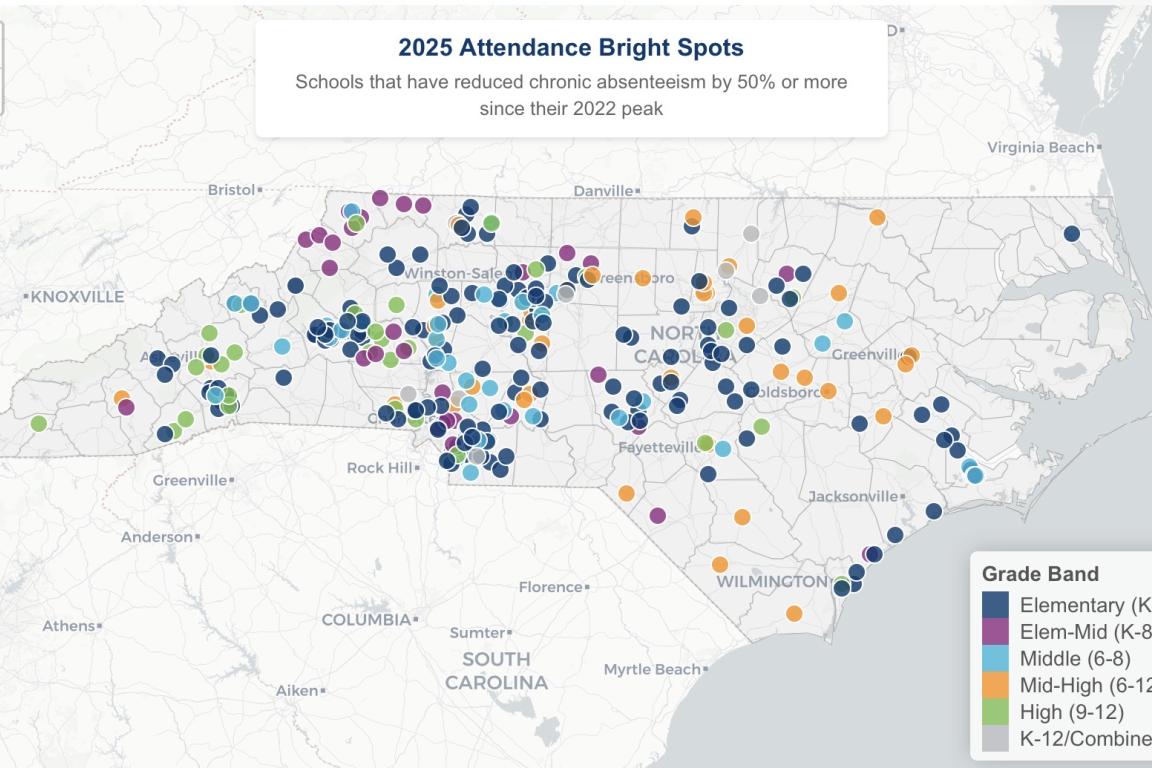
As you review your attendance data and build your school improvement plan, explore North Carolina’s Attendance Bright Spots to see which schools have made unusually strong progress in reducing chronic absenteeism. The Bright Spots map and dashboard can help your team identify comparable schools, surface practical ideas worth exploring, and inform questions for planning, site visits, and continuous improvement.
Going Deeper: Tiered Attendance Strategies
This section provides a practical set of attendance strategies for teachers, school teams, and school leaders informed by AttendNC Counts' review of the research and FutureEd's Attendance Playbook. The tiered structure helps schools start with strong everyday routines that support most students, add targeted supports when absences accumulate, and coordinate intensive case management when barriers are persistent or complex. Each strategy includes a plain-language description, a brief research summary, and a short set of first steps with an implementation resource drawn from Attendance Works and other sources.
Tier I: Universal Prevention and Enabling Conditions
Goal: Increase daily attendance by building a positive school experience and reducing routine hurdles for families.
Tier I strategies are everyday classroom and school routines designed for all students. They focus on reducing barriers, strengthening relationships, and making expectations and supports clear for students and families. When Tier I is consistent, fewer students need additional intervention and school teams have a stable foundation for responding when early warning signs appear.
Tier I family engagement is less about one-time events and more about a supportive communication rhythm that is specific, actionable, and non-blaming. Effective communication reduces confusion about absences, normalizes early problem-solving, and makes it easier for families to ask for help before patterns become entrenched.
Studies of “attendance nudges” show modest but reliable reductions in absences when messaging is personalized, repeated, and framed around accurate information (not shame). In a large-scale randomized experiment, Rogers and Feller found that providing caregivers with accurate, easy-to-understand information about their child’s absences reduced total absences and chronic absenteeism, especially when messages corrected caregivers’ underestimates and were delivered in multiple rounds. The research on parent messaging suggests that timing, clarity, and a supportive tone matter as much as content.
Getting Started:
- Establish a rhythm: weekly messages early in the year; every 2 weeks once routines stabilize; escalate to weekly for flagged students
- Use a consistent format: a specific fact, why it matters, one next step, help pathway
- Make replies actionable: name an owner, set a response window, and define when to escalate to student support staff
The Attendance Works Showing Up Matters for R.E.A.L.” Toolkit includes ready-to-use messaging guidance and examples grounded in a whole-child frame, helping schools build a supportive cadence without sliding into blame or compliance-only language.
A brief, consistent welcome routine supports attendance by strengthening relationships and reducing the social friction that can make returning after an absence feel harder than it should. Common strategies include greeting students by name at the door, a quick positive prompt, and a warm “welcome back” after missed days, all designed to create a predictable sense of belonging with very little instructional disruption.
Studies of proactive relationship building routines show improvements in engagement and behavior, which are closely tied to attendance risk over time. In an experimental evaluation of Positive Greetings at the Door, Cook and colleagues found increases in time engaged and reductions in disruptive behavior in middle school settings. Effects are more likely when greetings are consistent across days, paired with clear behavioral expectations, and include a simple re-entry check-in after repeated absences.
Getting Started:
- Establish a routine: 10–20 seconds per student, every day, with an intentional “welcome back” after absences
- Make it consistent: same entry point, same adult coverage plan, same language expectations
- Add a light check-in: if a student misses 2+ days in 2 weeks, pair the greeting with a 60-second check-in and a handoff to supports if needed
Attendance Works, "Strategy 1: Build Positive Relationships" provides practical guidance for welcoming routines, taking attendance in a caring manner, and strengthening connection so students feel noticed and wanted.
Engagement-oriented instruction supports attendance by increasing the likelihood that students experience school as meaningful and worth being present for. Practical approaches include frequent real-world curriculum connections, structured choice in task format, short reflection prompts on purpose and relevance, and regular opportunities for students to shape classroom norms.
A growing body of evidence on culturally relevant coursework and sustained engagement-focused instruction is linked to improvements in attendance and longer-term engagement, especially when implemented coherently rather than as isolated activities. In a study of a ninth-grade ethnic studies course, for example, researchers found improved academic outcomes for participating students, including improved attendance-related outcomes such as course performance and engagement indicators, with the strongest benefits for students most at risk academically.
Getting Started:
- Add relevance routines: weekly “why it matters” reflection and choice in assignments or activities
- Use student voice with follow-through: “what we heard and what we changed” posted monthly
- Support consistency: shared planning time, aligned materials, and quick walkthrough look-fors
Attendance Works, Relevant, Engaging Learning, provides practical guidance and examples for designing instruction that connects to students’ lives and increases motivation to attend.
Students are more likely to attend when school reliably delivers connection, especially peer connection. Tier I strategies that reduce “social friction” include structured advisory/homeroom, cooperative routines that ensure every student is seen and heard, and low-barrier clubs/teams that make it easier for students to feel known and included.
Research on connection-building approaches suggests attendance benefits are most likely when participation is predictable, adult-facilitated, and sustained long enough for relationships to form. For example, a rigorous study of a cross-age peer mentoring program for ninth graders found improvements in measures tied to school attachment, with stronger impacts among students who participated at a sufficient “dose,” underscoring the importance of participation thresholds, scheduling, and implementation follow-through.
Getting Started:
- Protect belonging time: a weekly advisory routine with simple prompts, roles, and norms
- Engineer peer contact: cooperative structures in class and at least one “anytime join” activity option
- Make re-joining easy: a peer buddy and brief re-entry routine after multi-day absences
Search Institute's Developmental Relationships Framework offers a practical set of relationship actions (e.g., express care, challenge growth, provide support, share power, expand possibilities) that teams can translate into advisory routines, classroom participation structures, and staff “look-fors.”
Well-designed recognition and incentives can reinforce attendance norms by making “showing up” visible, celebrated, and worth repeating, especially for students who are rebuilding good attendance habits. The most effective approaches avoid “perfect attendance” contests and instead recognize improvement, short streaks, and persistence (including strong return-to-school behavior after absences), and use rewards that are small, timely, and inclusive.
The research on attendance incentives show mixed results: some studies find short-term gains, while others show limited effects or backfire when awards unintentionally reward already-advantaged students. Incentives are more likely to help when they (1) focus on near-term, attainable goals (weekly/monthly), (2) emphasize improvement and “bounce-back,” (3) provide frequent feedback, and (4) are paired with relationship-building and barrier removal rather than used as a standalone fix. In a randomized field experiment, Steven Levitt (of Freakonomics fame) and his co-authors tested monthly performance-based incentives for high school freshmen (including attendance as one component) and found positive impacts on student outcomes.
Getting Started:
- Set inclusive recognition rules: prioritize improved attendance, “best bounce-back,” and short streaks (3–10 days), not perfect attendance
- Use short cycles: weekly classroom recognitions and monthly schoolwide recognitions to keep goals attainable and feedback timely
- Create multiple ways to earn recognition: individual improvement, team/advisory improvement, and “on-time all week” options to reduce inequity
- Pair recognition with support: when students miss, respond with help (transport, health, re-entry planning) so recognition doesn’t become exclusionary
- Keep rewards simple and sustainable: privileges, leadership roles, shout-outs, raffles with low-cost items, and family-positive recognition (not expensive prizes)
Attendance Works' Strategy 3: Recognize Improvements provides practical guidance on designing recognition systems that emphasize improvement, avoid perfect-attendance traps, and include examples of low-cost, equitable incentives schools can implement quickly.
Tier II: Early Intervention and Rapid Problem-Solving
Goal: Respond quickly when attendance starts to slip so early patterns don’t become long-term problems.
Tier II strategies are targeted, time-bound supports for students showing early signs of attendance risk. They rely on clear entry criteria, reliable follow-through, and short-cycle monitoring to see whether attendance improves within weeks. Strong Tier II strategies stay focused and repeatable so teams can deliver supports consistently and escalate when students are not responding.
Tier II attendance work starts with speed and routine: identifying students with emerging patterns (e.g., multiple absences in a short window or approaching 10% missed time) and responding with a consistent, team-based problem-solving cycle. Strong Tier II routines typically combine weekly data review, quick follow-up with students and caregivers, and a short menu of supports that can start immediately, not “later when we have time.”
Rigorous studies of early warning approaches show that structured data routines can reduce chronic absence, especially when schools use clear thresholds for intervention, meet regularly, and assign owners for support follow-through. In a randomized study of the Early Warning Intervention and Monitoring System (EWIMS) in 73 high schools, schools using EWIMS had a lower share of chronically absent students after one year than control schools. Impacts were achieved even though implementation was challenging, highlighting that results depend on protecting meeting time, keeping the process simple, and ensuring teams can act on what the data shows.
Getting Started:
- Set “Tier II triggers”: e.g., 2 absences in 2 weeks, 4 absences in a month, or trending toward 10% missed time
- Run a weekly cycle: review student list → assign outreach → select supports → monitor in 2 weeks
- Make follow-through visible: student support tracker to record action taken, next step, and date to review
The American Institutes for Research EWIMS Implementation Guide provides a step-by-step, school-friendly process for building an early warning team, setting thresholds, selecting interventions, and monitoring progress.
When absences begin to accumulate, Tier II outreach shifts from general messaging to personal problem-solving. Schools move quickly to connect with caregivers, learn what’s driving absences, and co-develop a practical plan (e.g., transportation, routines, health, safety, peer conflict, academic support). For families who are disconnected or hard to reach, relational home visits (or visits in a community location) can restart trust and open a path to supports.
The evidence base suggests targeted home visits can produce meaningful attendance gains when they are voluntary, relational, and repeated, and when schools have the infrastructure to identify the right students and follow up after the first visit. In an evaluation of Connecticut’s Learner Engagement and Attendance Program (LEAP), targeted home visits for chronically absent and disengaged students were associated with measurable increases in attendance in the months following the first visit, with larger gains over time, underscoring the importance of sustained outreach and a clear process for follow-up.
Getting Started:
- Move fast: schedule an attendance problem-solving conversation after the first clear pattern (not after “truancy-level” counts)
- Use a consistent script: strengths, “what’s getting in the way,” one doable action, a help pathway for parents
- Escalate to visits when needed: if contact attempts fail or barriers are complex, offer a voluntary home/community visit and plan the next touchpoint before leaving
The Connecticut State Department of Education's LEAP Website outlines practical steps, staffing expectations (pairs), visit structure, and follow-up routines for targeted Tier II re-engagement visits.
Many students with emerging absenteeism need one reliable adult who notices quickly, problem-solves barriers, and helps them rebuild routines. Tier II mentoring models typically include regular check-ins, attendance monitoring, goal-setting, and connecting with families. These are often delivered by a counselor, mentor, teacher, or trained near-peer. The goal is simple: reduce the number of “unnoticed” absences and create a steady relationship that pulls the student back to school before patterns take root.
Research on mentoring/monitoring models shows attendance benefits when programs are structured, mentors have manageable caseloads, and mentors have access to timely attendance data. A large-scale randomized controlled trial of Check & Connect program in Chicago Public Schools found reductions in absences for some grade bands, illustrating how consistent monitoring plus relationship-based support can improve attendance when implemented with sufficient dose and fidelity.
Getting Started:
- Set a simple scheduled: brief check-in at least weekly and a same-day response after an absence
- Keep caseloads manageable: assign a primary mentor and clarify who contacts home and when
- Track “dose” and outcomes: document contacts and review attendance every 2–4 weeks to adjust supports
Attendance Works' Mentoring: Elementary Success Mentors Toolkit includes role guidance, scripts, tracking tools, and practical tips for launching an attendance-focused mentoring model.
Some attendance problems reflect disengagement, peer dynamics, or skill gaps such as self-regulation, conflict management, motivation, or coping. Tier II engagement programs provide structured small-group experiences that are often paired with mentoring or tutoring and that build social-cognitive skills and strengthen students’ identity as learners. These supports are typically offered to a targeted group (e.g., students with rising absences, course failures, or behavior referrals) rather than the whole school.
Evidence suggests that targeted programs combining skill-building (often rooted in CBT-style approaches) with consistent adult support can reduce absences for some student groups, especially when delivered with adequate intensity and strong implementation. A randomized experiment of the Becoming a Man program in Chicago found substantially reduced absences for participating youth when paired with academic supports.
Getting Started:
- Target intentionally: prioritize students with rising absence and engagement flags (e.g., course issues, conflicts, withdrawals)
- Protect time and attendance: schedule sessions during consistent blocks and build a “missed session” make-up plan
- Link to school routines: connect group work to daily check-ins, teacher feedback, and family communication
Youth Guidance's Why BAM Works describes the core program components and delivery expectations that schools can use to vet fit and plan implementation.
A sizable share of Tier II absences are driven by health barriers (e.g., asthma flare-ups) or mental health concerns that show up as school avoidance or refusal (anxiety, depression, panic symptoms, somatic complaints). Tier II practice focuses on quick identification, practical accommodations, and school-connected supports (nurse protocols, counseling groups, gradual re-entry plans, and coordinated caregiver routines) so students can return safely and consistently.
Research shows that improving access to health care and behavioral health supports can reduce absenteeism when services are easy to access during the school day and coordinated with school staff. In a quasi-experimental study of school-based telemedicine clinics in rural North Carolina districts, opening telemedicine access was associated with reductions in chronic absenteeism, suggesting that reducing the “friction” of care (e.g., time, transportation, appointment access) can translate into better attendance.
Getting Started:
- Add a simple screening step: for repeated health/avoidance absences, identify likely driver (health management vs. anxiety/avoidance vs. both)
- Create a re-entry plan: short, specific steps for return (partial days if needed), plus daily check-ins for 2–3 weeks
- Use accommodations early: 504/IEP-aligned supports when appropriate; reduce avoidable triggers and academic overwhelm
The School Refusal: Assessment and Intervention resource from the Center on Positive Behavioral Interventions & Supports (PBIS) offers a practical overview of school refusal, assessment considerations, and school-based intervention approaches (including gradual exposure/re-entry planning).
Tier III: Intensive, Coordinated Intervention and Case Management
Goal: Address persistent or complex barriers through coordinated, individualized plans that ensure students and families connect to effective supports.
Tier III strategies are intensive and individualized supports for students with chronic or severe absenteeism, particularly when barriers are complex (e.g., health, housing instability, mental health, caregiving responsibilities, family crisis) or when Tier II has not been sufficient. Tier III typically requires a designated case lead, coordinated school-team planning, and strong partnerships with community agencies to provide “warm handoffs” and verify connections, not just referrals. Tier III is most effective when plans are practical and measurable, follow-up is frequent, and systems track whether supports are actually delivered and barriers are reduced over time.
Tier III support is for students with severe, persistent absenteeism where barriers are complex and often extend beyond school (e.g., housing instability, behavioral health needs, foster care involvement). An essential strategy is to assign a single case lead who coordinates a plan with the student and family, organizes the right supports, and follows through until the student’s day-to-day attendance stabilizes.
Research on intensive case management shows that it can improve connections to supports and strengthen students’ relationships and attitudes toward school, but attendance gains are not automatic and depend on whether services are timely, high-quality, and matched to the student’s needs. In a two-year randomized study of Communities In Schools case management, students received more support services and reported improvements in nonacademic outcomes, but there were no overall impacts on attendance. Cross-agency models like these show stronger results when partners share timely data and operate with a single coordination point. The NYC “Attendance Matters” shelter partnership, for example, improved attendance partly because agencies had daily attendance updates, defined roles, and coordinated problem-solving across education and homelessness systems.
Getting Started:
- Name a case lead: assign one adult responsible for the plan, follow-up, and coordination across supports
- Build one plan with the family: identify top 1–2 barriers, define actions, and set a weekly attendance goal
- Run a weekly progress loop: review attendance, confirm whether supports “landed,” adjust quickly when they did not
Attendance Works' Student Attendance Success Plans (with My Family’s Help Bank) provides simple templates to set goals, identify barriers, and document concrete back-up plans with families.
For students experiencing homelessness or frequent moves, Tier III attendance work is less about motivation and more about stability: immediate enrollment, transportation, predictable routines, and coordinated support with liaisons and community partners. The goal is to make school the most stable part of a student’s week.
Shelter- and system-linked attendance supports show promising results when agencies share timely data and solve logistics quickly. In an evaluation of New York City’s “Attendance Matters” shelter-based program, students in participating shelters missed about two to three fewer days of school and had lower absence rates than peers in non-participating shelters; the approach also improved school stability (i.e., fewer school changes). Key components included daily attendance data, cross-agency coordination, and staff training in trauma-informed practices and motivational interviewing.
Getting Started:
- Identify and stabilize fast: ensure same-day enrollment support and immediate connection to the McKinney-Vento liaison
- Solve transportation now: confirm transport plan within 48 hours (bus routing, passes, or alternative options)
- Reduce “school switching” friction: prioritize continuity of placement when feasible and align records/credits quickly
The National Center for Homeless Education's McKinney-Vento Toolbox offers step-by-step tools for enrollment, transportation, dispute resolution, and liaison duties to keep students connected to school.
When absenteeism is driven by anxiety, avoidance, or school refusal, Tier III focuses on a structured re-entry plan that reduces avoidance gradually while strengthening safety, predictability, and adult support. Done well, the plan protects dignity: it is non-punitive, highly coordinated, and designed to prevent “two steps forward, one step back” cycles.
Evidence supports cognitive-behavioral therapy (CBT) approaches that pair skill-building with a gradual return to feared settings, especially when schools coordinate closely with caregivers and providers. A feasibility study of Back2School, a modular, CBT-based approach for youth with school attendance problems, illustrates the core elements: individualized plans, flexible modules matched to function, and coordinated supports that target both attendance and distress.
Getting Started:
- Do a quick functional assessment: clarify what the student is avoiding school (peers, evaluations, separation, etc.) and why
- Create a graded return plan: start with a “smallest next step” schedule (partial-day, safe space, first-period anchor) and increase weekly
- Assign a re-entry anchor adult: one daily check-in/check-out, with clear escalation steps if the student misses
School Avoidance Alliance's Resources for Educators provides a practical roadmap, prevention tips, and re-entry guidance for supporting students back to school.
Students involved in child welfare or the justice system often face rapid placement changes, enrollment gaps, and fragmented adult responsibility. Tier III success comes from “one team, one plan”: a consistent education champion, coordinated meetings, and a fast-response process for re-enrollment, credits, and daily attendance.
Evaluations of education-stability models suggest they can reduce time out of school by tightening coordination and accountability across adults. In RTI’s evaluation of FosterEd Arizona’s statewide expansion, youth receiving intensive FosterEd supports experienced fewer enrollment gaps and less total “out-of-school time” (absent or unenrolled) than comparison youth, pointing to the value of an organized team structure, access to education data, and frequent check-ins.
Getting Started:
- Identify an education champion: confirm the adult who will show up to meetings and ensure follow-through
- Hold a short, recurring team check-in: every 2–4 weeks (school + caregiver + agency partners) focused on attendance and credit progress
- Prioritize continuity essentials: transportation, enrollment/records transfer, credit recovery options, and a stable daily “start” routine
U.S. Department of Education, “FERPA and Community-Based Organizations” clarifies how schools can share information appropriately to coordinate services with partners supporting high-need students.
For students accumulating many unexcused absences, Tier III requires a shift to a structured, support-first escalation pathway. The aim is to resolve barriers, monitor how absences are labeled, and reserve court involvement for rare cases where supportive problem-solving has been exhausted and safety/legal requirements compel action.
Studies of court diversion and truancy interventions show mixed results, with several finding no meaningful attendance improvements, especially when programs function more like compliance systems than barrier-removal supports. A quasi-experimental study of a truancy diversion program found no long-term improvements in attendance, reinforcing the need for early, practical supports and careful design rather than assuming “referral = impact.” Additionally, analyses of unexcused absence labeling show substantial disparities by race/ethnicity and socioeconomic status, making monitoring and bias checks a Tier III necessity.
Getting Started:
- Audit unexcused labeling: review who is marked unexcused and why; correct policy/practice inconsistencies
- Use an absence intervention team: require a documented plan (barriers, supports, timelines) before any legal escalation
- Keep students in school: avoid responses that increase missed instructional time (e.g., suspensions for truancy)
The CSG Justice Center's Support or Court outlines evidence-informed approaches for keeping youth out of the justice system when possible and strengthening support-first responses to truancy/status offenses.
This page was last modified on 06/24/2026