
This fall, State Superintendent Maurice “Mo” Green and other leaders hosted launch events in each region of the state for the North Carolina Department of Public Instruction and the State Board of Education’s joint strategic plan, “Achieving Educational Excellence.”
Educators in each region are sharing their reflections about the tour stops, which include several school visits during the day and a public presentation on the strategic plan in the evening. Learn more about the strategic plan by visiting the NCDPI website.
Dr. Anthony Martin
The 2025 Burroughs Wellcome Fund Sandhills Region Teacher of the Year, Martin teaches technology, engineering and design at East Columbus Junior/Senior High School (Columbus County Schools).
The day began before sunrise, windshield wipers keeping time on a 90-minute drive through steady rain. I had an agenda, but I tried not to script my expectations. Instead, I decided to let the day unfold and take in each stop as it came.
Our first destination was Richmond Senior High School, a place I hadn’t visited in about 15 years. The morning began with a light breakfast prepared and served by the school’s culinary students. I was planning to grab an English muffin breakfast sandwich and call it a morning, but one student looked me straight in the eye and said, “You’ve got to try one of these muffins.” He was right, it was fantastic.
The conversations that followed over breakfast set the tone for the day. From board members to district leaders, every person we met spoke with a clear, genuine focus on students. It didn’t feel rehearsed. The excitement around their new Career and Technical Education (CTE) building, funded through ESSER resources, was contagious. The new spaces were bright, functional and designed for learning that looks forward, not backward.
The health occupations lab immediately stood out. The room’s flexibility, its balance of bright and soft lighting, and especially the digital anatomy table, a full 3D interactive visualization tool, represented a leap in how students can learn about the human body. It’s one thing to study a plastic skeleton; it’s another to explore real human anatomy rendered in lifelike detail.
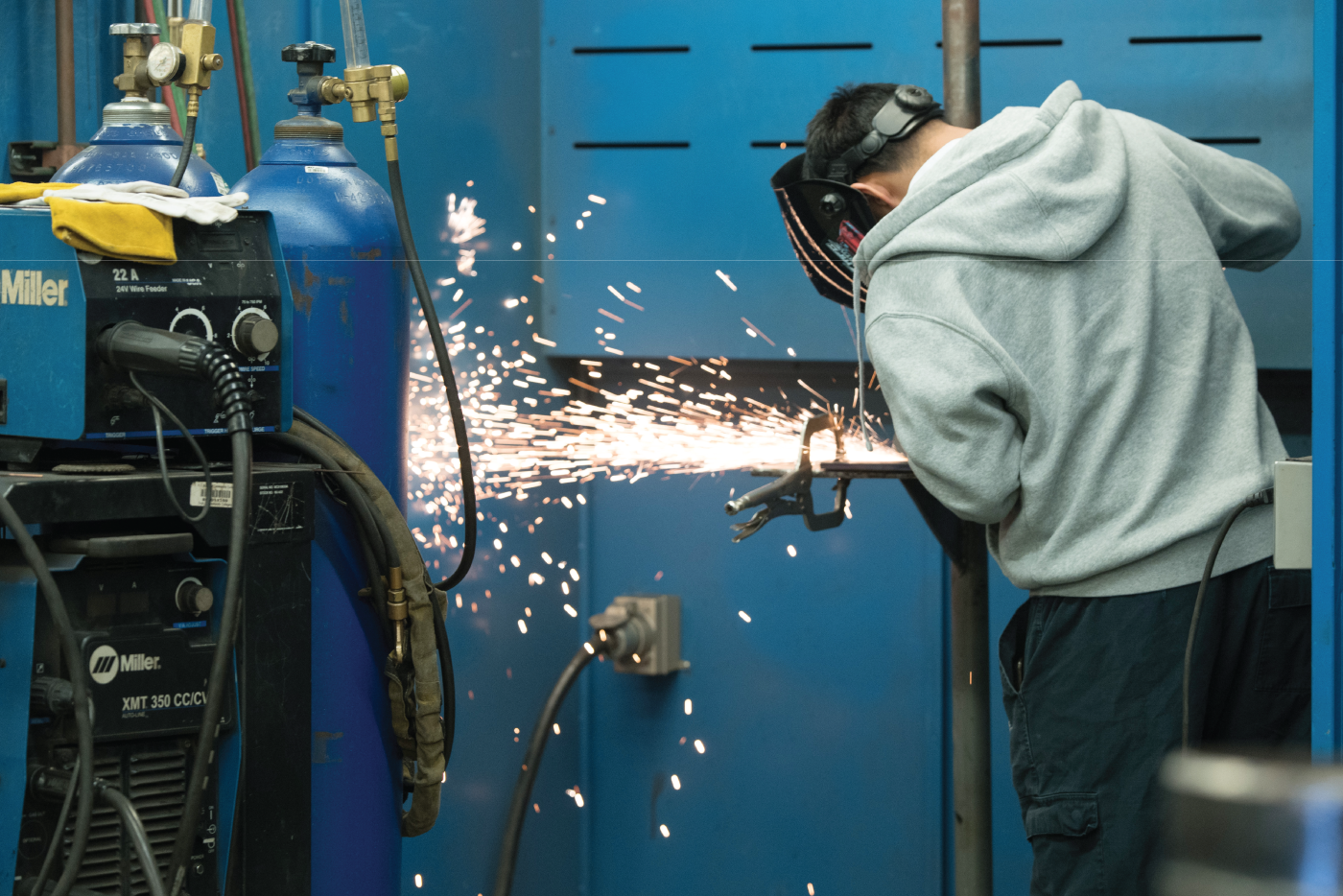
We also visited the electrical, automotive and welding programs. There’s something powerful about seeing older facilities maintained with care, evidence of long-term commitment. In the welding lab, students trained on high-end equipment identical to what we’d later see at Richmond Community College. It was here we learned that a recent graduate, barely a year or two out of high school, is now earning $90,000 a year. That kind of success story isn’t just a headline; it’s proof that high-quality career and technical education changes lives.
At Richmond Community College, the relationship between the college and the school district was seamless, exactly what you hope for when K–12 and higher education share a mission. Their health sciences and welding labs echoed the high school’s programs, creating a clear and connected pathway for students. You could sense mutual respect between the instructors and administrators. The flow from one system to the next felt natural, with no barriers, just opportunity.
We also heard from Dr. Quinn Jernigan of Amazon Web Services, who spoke about the company’s forthcoming $10 billion investment in Richmond County and how it’s already building bridges with local schools. AWS is working together with educators to develop programs in fiber-optic splicing, pre-apprenticeships and advanced infrastructure training. It was inspiring to see education and industry collaborating so early and intentionally.
At UNC Pembroke, the focus shifted to Pillar 2: Revere Educators. Part of revering educators means investing in their preparation, and UNCP is setting the standard. Their educator preparation programs are producing confident, well-supported graduates who return to teach in the same communities that raised them. That full-circle story of “homegrown teachers” is exactly what strong public education should look like.
The day continued with a visit to the construction site of Robeson County’s new Career and Technical Education Center, an architectural and educational gem made possible by a needs-based grant. The facility, complete with a planetarium and spaces designed for reverse internships, will give students an environment that’s both beautiful and inspiring. It represents a belief that rural schools deserve not only functionality but also wonder.
We ended the evening at Lumberton High School, where Superintendent Green presented the state’s Strategic Plan for Public Education and its eight pillars. Despite the heavy rain outside, the atmosphere was bright with optimism. Many who attended were already champions of public education, but you could feel them leave even more galvanized, ready to carry that message forward.
On my drive home through the same steady rain, I realized I didn’t mind the weather anymore. The day had been full of warmth, collaboration and hope. The sun may not have been shining over the Sandhills, but in every classroom, partnership and conversation, it absolutely was.
Dr. Laura Bailey
Bailey is the principal of Scotland High School (Scotland County Schools) and the 2025 Wells Fargo Sandhills Region Principal of the Year.
My recent tour through North Carolina’s Sandhills Region reminded me of something important: some of the most innovative, student-centered work in Career and Technical Education is happening in our rural districts. These districts aren’t waiting for opportunity to arrive — they’re building it, shaping it and partnering to make sure every student has a pathway to success.
One of the first stops on my tour was Richmond County Schools, where I saw firsthand the incredible work happening in their CTE programs. From advanced technical training to hands-on career pathways, students are gaining real-world skills that prepare them for both today’s workforce and tomorrow’s opportunities.
And yes — I have to admit — as the principal of Scotland High School, it was a challenge surrounded by so much green. However, the great things happening at Richmond Senior High School definitely made up for it.
Across Richmond County Schools, one theme kept coming up: the power of partnership. The collaboration with Richmond Community College is truly a model for the state. Students have access to dual enrollment, workforce pathways and industry-aligned training that set them up for immediate success. These partnerships prove that when K-12 and community colleges work hand-in-hand, students win every time.
One of the most exciting pieces of news from the region: Amazon’s new AI headquarters is coming to Richmond County. This development is more than an economic boost — it signals new career opportunities for students and strengthens the importance of CTE programs that prepare learners for advanced technology, automation and artificial intelligence fields. The future is arriving quickly in the Sandhills, and our students are ready for it.
My visit to UNC Pembroke was an absolute highlight. Enrollment in their teacher education programs is up, and that alone is worth celebrating. At a time when recruiting educators is a statewide priority, seeing students choose the teaching profession — and seeing strong programs to support them — filled me with hope.
If you want to feel excited about the future of CTE, just visit the new career center currently under construction in Robeson County. Even in its unfinished state, it is already impressive. The design, the purpose, the intentionality behind every space — it’s clear this center will open doors for students in ways we haven’t seen before. I cannot wait to go back when it is completed. It’s going to be a game-changer for the region.
My stop at Robeson Community College only reinforced something I saw at every point on this tour: our public schools and community colleges are working together in powerful, meaningful ways. From shared programming to aligned pathways and industry-led credentialing, these partnerships ensure students have a seamless path from high school to higher education to high-quality careers.
To wrap up the tour, I had the chance to hear Superintendent Green share his strategic plan at Lumberton High School. His vision, grounded in community needs and student opportunity, reflects everything I witnessed across the region: dedication, collaboration and a commitment to making sure every student — no matter where they live — has access to world-class educational experiences.
Rural districts are often described in terms of what they lack — but my tour through the Sandhills Region made something crystal clear: These districts are full of innovation, opportunity and partnerships that rival any in the state.
From the new AI headquarters to rising teacher-prep enrollment, from cutting-edge construction projects to community-driven leadership, the Sandhills is showing everyone what’s possible when we invest in students and work together.